

How to Hire a Set Medic: A Producer's Guide to Medical Cover on Production

Nobody puts a set medic in the budget because they expect an emergency. They put one in because a 14-hour day, a night shoot in February, a stunt driver, 200 background actors, or a hot set full of cable is a risk profile that would make any safety officer in any other industry sit down.
Most days the medic hands out ibuprofen and electrolyte tabs and treats a grip's sliced thumb. On the day it matters, they are the reason a serious injury doesn't become a fatality — and the reason your production doesn't become the case study everyone else's safety meeting references.
If your production needs immediate on-site medical care, proactive health-risk management, and a safer working environment, hire a qualified set medic.
A set medic will:
Provide Emergency Response: Treating sudden injuries, severe allergic reactions, or accidents instantly while waiting for an ambulance.
Offer Daily First Aid: Manage minor issues such as cuts, burns, dehydration, heat exhaustion, and headaches with over-the-counter medications or basic supplies, thereby reducing downtime.
Hazard Prevention: Proactively spots safety hazards during stunts, pyrotechnics, or difficult terrain (like water or high locations).
Logistics & Compliance: Maps out the fastest routes to local hospitals, coordinates emergency contacts, and fulfills legal duty-of-care or insurance requirements.
Medical Liaison: Acts as the communication bridge between injured staff and off-site emergency medical facilities.

Here's how to hire the right one.
When Does a Production Need a Medic?
There is no single federal rule that says, "every set needs a medic." What you have instead is a stack of overlapping obligations, and in practice most productions of any scale are covered by at least one of them.
Occupational safety requirements. OSHA and state equivalents such as Cal/OSHA require first-aid provisions and, when medical facilities are not in near proximity to the workplace, a trained first-aid provider on site. Location shoots in deserts, forests, on rural highways, or at remote ranches routinely fail the “near proximity” test.
Insurance and completion bonds. Your carrier or bond company may simply require it. Read the policy before you decide it's optional.
Studio, network, or streamer requirements. Most have their own safety departments with standards well above the legal minimum.
Beyond compliance, bring a medic on when the day includes any of these:
Stunts, fight choreography, or falls.
Firearms of any kind — including blanks and non-guns.
Pyrotechnics, fire, or special effects atmosphere.
Water work, boats, or diving.
Aerial work, cranes, scaffolding, or condor lifts.
Picture vehicles, process trailers, or any driving sequence.
Animals on set.
Extreme heat, extreme cold, or high altitude.
Night shoots and long turnarounds.
Remote locations with slow EMS response.
Large background counts — crowd days generate injuries by volume alone.
Minors, elderly performers, or performers with disclosed medical conditions.
VIP or celebrity talent.
If your day has firearms or stunts, the answer isn't just a medic. High-risk sequences often warrant a standby ambulance, a fire safety officer, and a documented emergency action plan rehearsed before the first take.
Know What You're Hiring
"Set medic" is a job description, not a credential. The underlying qualification matters.
EMT (EMT-B) — Provides basic life support, including airway management, bleeding control, splinting, oxygen administration, and AED use. This is the standard level on many productions, sufficient for most shoot days, and usually the most cost-effective option.
AEMT / Paramedic — Adds IV access, cardiac monitoring, and medications. Worth the upgrade for remote locations, long EMS response times, stunt-heavy schedules, or extreme environments.
Registered Nurse — Strong on assessment, documentation, and managing performers with existing conditions. Often paired with EMS-credentialed staff rather than replacing them.
Wilderness EMT or Paramedic — Specifically trained for delayed-transport and austere environments. The right call for backcountry, desert, or mountain locations.
Set medic with production experience — This is the real differentiator, and it sits on top of any of the above.
Verifying Credentials — Don't Skip This
Verify every item, in the state where you're actually shooting:
State or National EMS certifications for the filming state. Productions frequently get this wrong. A California-licensed EMT is not automatically authorized to practice in Georgia or New Mexico. If you are shooting across state lines, confirm that the medic is properly credentialed in every applicable state.
NREMT status and expiration date.
BLS, and ACLS/PALS where appropriate to the level.
Physician medical direction and written standing orders — without these, a paramedic's advanced scope is largely theoretical.
Professional liability insurance, and confirmation it covers entertainment work.
Whether the medic is hired as crew through your payroll or provided by a medical services company. This determines who carries workers’ compensation and general liability coverage, and it must be settled before day one. If you do not carry specific medical malpractice coverage, hire an independent company with appropriate insurance and require it to name your production as an additional insured.
References from ADs and production managers, not just clinical supervisors.
The Part Most Producers Underestimate
A brilliant 911 paramedic can be a disaster on set. The clinical skills transfer; the environment does not.
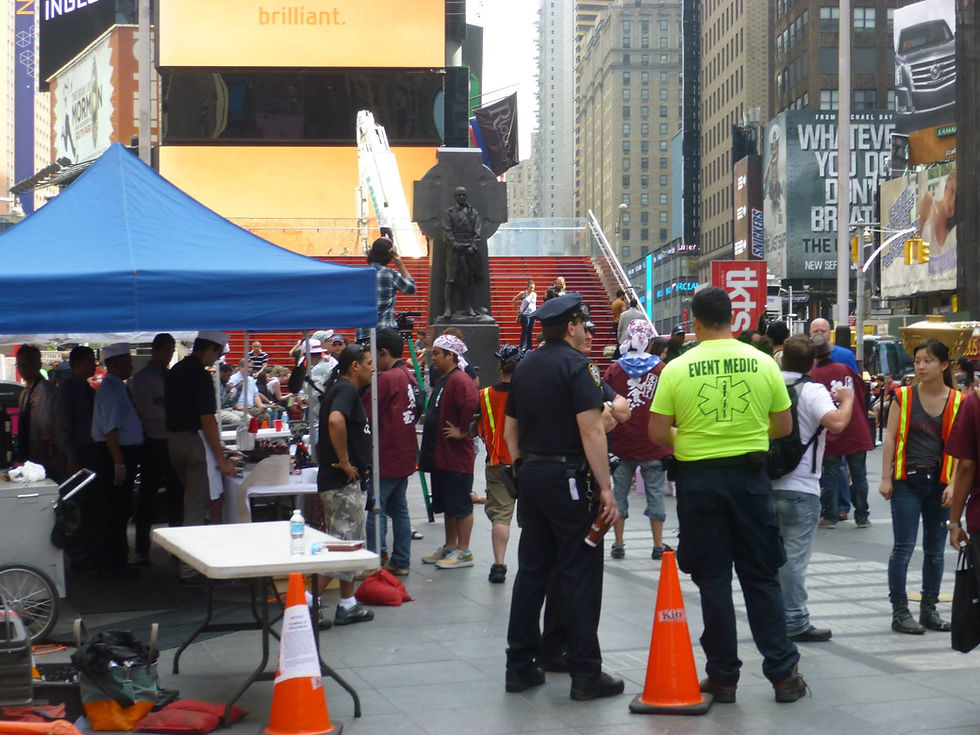
A good set medic knows not to walk through a shot, understands what "rolling" and "hot set" mean, keeps a radio channel and uses it sparingly, and can treat a lead actor's blister discreetly in their trailer rather than in front of forty crew members. They understand that a performer disclosing a medication or a condition is confidential information that does not travel to the UPM, and they know the narrow set of circumstances where it has to.
They also know when to stop the day. That's the hardest part of the job. A medic who will tell a 1st AD that a performer is showing early heat exhaustion and needs to come out of the costume — while the light is going — is worth several times one who won't.
Interview for exactly that:
Walk me through your first hour on a new location.
Where do you position yourself during a stunt sequence, and what do you need from the AD department beforehand?
A department head asks what's wrong with one of the actors. What do you say?
It's 96 degrees, we're four hours from wrap, and background is in wool coats. What do you do?
Tell me about a time you called a stop, and it wasn't popular.
Booking, Budgeting, and Logistics
Where it lives in the budget. Set medic cost is typically structured as a day rate — booked either as crew or through a production medical services company — built around a standard shoot day with overtime beyond it. There's no single number, since set medic rates shift with credential level, location, and hazard exposure, but a standard EMT day rate is the baseline most budgets start from. Expect additional line items for a medical kit or box rental, mileage and travel, per diem on distant location, and a higher rate for paramedic-level or hazardous-condition days. Standby ambulances are booked and billed separately.
Get comparable quotes. Three providers minimum and make sure each quote covers the same thing: credential level, hours, kit included or rented, travel, and whether a second medic is required for split units. Consider sharing quotes across providers as you compare them. They're often better positioned than you are to explain what's actually driving the difference in price or scope. The decision remains yours, but their input can sharpen it.
Bring them in during prep, not on the day. A set medic who attends the tech scout can flag the access road an ambulance can't turn on, identify a helicopter landing zone, confirm the nearest trauma center rather than the nearest hospital, and check that the emergency information on the call sheet is actually correct. Most call sheets list a hospital that nobody has verified accepts trauma.
Give them standing at the safety meeting. The medic should be introduced by name at the top of the day, their position on set should be known, and the radio channel should be on the call sheet.
Second unit and splits need their own coverage. One medic cannot cover two units in two locations. This is a budgeting question that gets discovered late and expensively.
Red Flags
Can't produce a license for the state you're shooting in
No named medical director or standing orders
Vague about insurance, or expects the production to carry all of it without discussion
No production references
Talks only about trauma response and can't discuss heat illness, hydration, documentation, or confidentiality
A rate far under market — usually an uninsured operator or an under-credentialed one
Unwilling to attend the scout or the safety meeting
Frequently Asked Questions
Is a set medic legally required on a film production? It depends on jurisdiction, union agreement, and the content of the shoot day. Occupational safety rules require first aid provision and trained personnel where medical facilities aren't nearby, and union safety guidance, insurers, and studios frequently impose stricter requirements. Verify against your state's rules and your specific contracts rather than assuming a default.
EMT or paramedic — which do I need? Match it to risk and distance. EMT is appropriate for most stage and urban location work with quick EMS access. Paramedic is warranted for remote shoots, stunt and firearms days, water work, and extreme environments.
Do I need a standby ambulance as well as a medic? For high-risk sequences — significant stunts, pyrotechnics, live fire, aerial work — often yes. A medic stabilizes; an ambulance transports. If your nearest unit is 30 minutes out, a medic alone leaves a long gap.
How far in advance should I book? Book during prep, alongside your other key crew. Experienced set medics on busy shooting schedules get committed early, and you want yours available for the tech scout.
Can our first aid-trained PA cover it? No. A first aid certificate is not a clinical license. PAs typically don't carry medical malpractice insurance, and most non-medical crew — however well-intentioned — can't reliably distinguish a heat emergency from a diabetic or cardiac event, even though the early symptoms can look alike. Few staff outside an experienced EMT would recognize a serious internal bleed or a developing head injury. Asking a PA to act beyond their training exposes them, the production, and the patient to real liability — and it pulls someone off the job they were actually hired to do.
Planning Your Next Shoot?
Stunts, water work, firearms, a remote location, a crowd day — every one of those changes what "covered" actually means, and the right call isn't always the level you'd guess. Tell us what your shoot days look like and we'll tell you whether you need an EMT, a paramedic, a standby ambulance, or all three — and where to book it in your prep schedule.

